‘Nigeria Must Fund Research in the Age of AI Or Risk Watching the Future Happen Elsewhere’
As the world enters a new technological era reshaped by Artificial Intelligence, a nation’s most valuable resource is no longer hidden beneath the soil. It is found in the minds of its people, the knowledge they generate, and the intellectual property they can protect. In this new reality, the question confronting Nigeria is urgent and direct: Will we invest boldly in research and secure our place in the future, or will we remain spectators as others define it?
For too long, national development has been equated with roads, power stations, and revenue debates. Important, yes—but only part of the story. The nations shaping the next century are those that fund research with the seriousness usually reserved for oil and national security. Today, intellectual property, not crude oil, forms the backbone of the world’s most powerful economies. AI has compressed time in unprecedented ways, accelerating discovery and transforming ideas into billion-dollar industries almost overnight.
Nigeria must not sit out this revolution.
The Ground Is Shifting
Artificial Intelligence is redefining every field it touches. From medicine to agriculture, logistics to energy, climate science to national security, AI is expanding the boundaries of what researchers can achieve. Countries that seize this moment are not necessarily the richest—they are the ones that act with clarity and intent.
Unfortunately, Nigeria’s research ecosystem has been chronically underfunded for decades. University laboratories struggle. Promising scientists leave the country. Private innovation depends on imported models and foreign infrastructure. Meanwhile, our population, one of the youngest and most dynamic on earth is bursting with talent but starved of the environments needed to convert that potential into knowledge creation. The danger is not merely falling behind. The danger is becoming permanently dependent on intellectual property produced elsewhere, paying rent on the innovations that govern our economy, security, and society.
But it doesn’t have to be this way.
Lessons From Countries That Refused to Be Left Out
Around the world, nations with fewer resources than Nigeria have taken decisive steps to define their intellectual futures:
● India, through decades of sustained investment in computing, higher education, and research labs, has become one of the world’s top AI research producers and a key global technology hub.
● Brazil built a public university system that leads Latin America in scientific output, with significant breakthroughs in fintech, agriculture, and climate analytics.
● Vietnam made a deliberate push into semiconductor and AI manufacturing, transforming itself into a critical player in global supply chains.
● Rwanda invested in digital governance, drone corridors, and data policy, turning itself into an African case study in research-led development.
● Saudi Arabia and the UAE committed billions to building research universities and AI institutes, fully aware that their oil wealth cannot guarantee influence in a future defined by algorithms and data.
These countries didn’t wait until their economies were perfect. They acted because they understood that those who control the next generation of ideas will control the next generation of industries.
Nigeria can do the same if we prioritize research as a national project.
Where Nigeria Can Lead: Untapped Research Frontiers in the AI Age
AI has collapsed barriers so quickly that entire fields that once required multi-decade investments can now be accelerated dramatically. Nigeria has natural strengths in several research domains where we can lead if we invest decisively:
Agriculture and Food Systems
AI can help decode soil behavior, crop responses, rainfall variability, and pest dynamics, allowing Nigeria to move from subsistence farming to science-driven food security. Research here isn’t academic; it is existential.
Health, Genomics, and Disease Modelling
Nigeria is home to some of the world’s most genetically diverse populations. This is an enormous scientific advantage for vaccine research, drug discovery, and personalized medicine. With the right research grants and genomic infrastructure, Nigeria could become a global center for tropical disease innovation.
Energy and Power Systems
From optimizing natural gas to improving solar efficiency, battery storage, and grid intelligence, AI can help Nigeria stabilize power supply and invent new energy technologies. Research here translates directly into industrialization.
National Security and Cyber Defense
Sovereignty in the digital age depends on algorithms. Research in encryption, cybersecurity, threat prediction, and autonomous defense systems is no longer optional.
Climate and Environmental Science
AI-driven climate models can help predict flooding, erosion, desertification, and water scarcity, some of the challenges that Nigeria will face with increasing intensity.
Financial Systems and Digital Economy
Nigeria’s vast, data-rich informal economy is fertile ground for research in identity systems, fraud detection, credit scoring, and financial inclusion, knowledge that can be exported globally.
Language Technology and Cultural AI
With over 500 languages, Nigeria holds one of the richest linguistic datasets in the world. AI research on African languages could unlock new cultural industries, new business models, and entirely new global markets.
Industrialization, Materials Science, and Manufacturing
AI can fast-track new discoveries in construction materials, consumer products, and energy storage laying the foundation for a real manufacturing renaissance. These are not
speculative ideas. They are real opportunities waiting for national commitment.
The Cost of Inaction: Intellectual Dependence
The biggest threat Nigeria faces is not a lack of talent, but the continued outsourcing of our intellectual future. When we import the world’s models, hardware, medicines, and algorithms without contributing to their creation, we pay a hidden tax: a dependency tax.
Every time we adopt foreign AI systems without local research capacity, we surrender a piece of our sovereignty. The future will not be negotiated; it will be coded. And if Nigeria does not meaningfully participate in that coding, our policies, industries, and culture will increasingly be shaped by knowledge produced elsewhere. This is the moment to choose differently.
A New National Vision for Research and Intellectual Independence
For Nigeria to become a true knowledge economy, several steps are essential:
● Treat Research as a Strategic Asset Just as nations protect oil fields and critical infrastructure, Nigeria must treat research as a national security priority.
● Create Serious Funding Mechanisms
Research cannot depend on goodwill or sporadic grants. It needs guaranteed national funding at levels that reflect the stakes.
● Modernize Universities into Research Engines
Our universities should be laboratories of discovery, not institutions fighting for survival. They should attract global faculty, build labs, and compete internationally.
● Adopt a National IP Strategy
Nigeria must protect its discoveries through patents, trade secrets, and licensing agreements. Countries that own intellectual property own the future.
● Empower the Next Generation of Researchers
Scholarships, fellowships, research residencies, and partnerships with global institutions will help build a pipeline of scientists and inventors.
● Foster Public–Private Research Ecosystems
Companies and universities should collaborate, co-fund labs, and jointly develop IP. This is how innovation ecosystems grow.
The Future Will Be Built by Those Who Create, Not Those Who Consume
Nigeria’s potential is undeniable. Our youth are hungry. Our culture is dynamic. Our people adapt quickly to new technologies. But potential without investment remains potential, and talent without infrastructure remains untapped.
The AI age presents a once-in-a-century opportunity to redefine who we are and what we contribute to the world. It is not enough to buy technology; we must build it. It is not enough to adopt innovation; we must author it. It is not enough to consume knowledge; we must create it and protect it.
Nigeria stands at a crossroads. The nations that will matter in the 21st century are already choosing to invest in research and own their intellectual property. The question is simple:
Will we?
Because the future will not wait for us to decide.
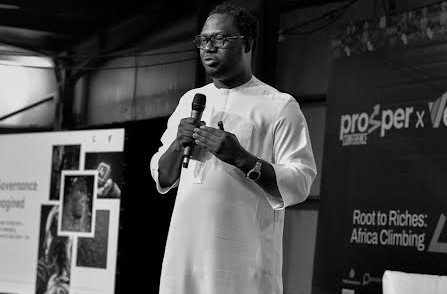
Olusola (Olu) Amusan is a modern African polymath and the Co-Founder/CEO of Vesti, the world’s first AI-powered super-app for immigrants, helping over 150,000 users from 131+ countries navigate relocation to North America and Europe.